
Table of Contents
- What AAC Awareness Month Is and Why It Matters
- Types of AAC: Aided, Unaided, and Everything In Between
- Benefits of AAC for Children and Families
- AAC Awareness Month Activities You Can Start This October
- AAC at Home: Practical Guidance for Communication Partners
- Myths, Misconceptions, and the Evidence Behind AAC
- Turning Awareness Into Everyday Communication Access
- Frequently Asked Questions
Last Updated: October 6, 2026
What AAC Awareness Month Is and Why It Matters
October is AAC Awareness Month, a yearly push to help more people understand augmentative and alternative communication and how it opens doors for kids who struggle to speak. At Project Speech, we see that gap up close: families walk in unsure what AAC even means, and they leave with a child who finally has a way to be heard. (Source: the prevalence of AAC use)
AAC Awareness Month matters because communication access is not a luxury. It is how a child asks for a snack, tells you they are hurt, or joins a joke at the dinner table. The whole point of aac awareness is simple: every child deserves a way to share what is on their mind.
Who Uses AAC and Why Awareness Matters
AAC is not one device or one diagnosis. It helps children with autism, genetic conditions, speech sound disorders, Childhood Apraxia of Speech, and language delays. Some kids use it for a season while their speech catches up. Others use it for life.
Here is the part most people get wrong: AAC does not stop a child from talking. American Speech-Language-Hearing Association on AAC notes that AAC can actually support speech development. Awareness matters because early access changes outcomes. When families know their options, kids start communicating sooner.
Types of AAC: Aided, Unaided, and Everything In Between
When parents first hear “AAC,” they often picture one device. In reality, AAC is a spectrum, and the right starting point depends on your child’s motor skills, vision, attention, and daily routines.
Unaided AAC uses only the body. No tool, no battery, nothing to charge. Examples include:
- Gestures, like reaching or waving
- Facial expressions and eye gaze
- Body language and pointing
- Manual sign language, such as American Sign Language or simplified sign systems
Unaided AAC is always available, which is its biggest strength.
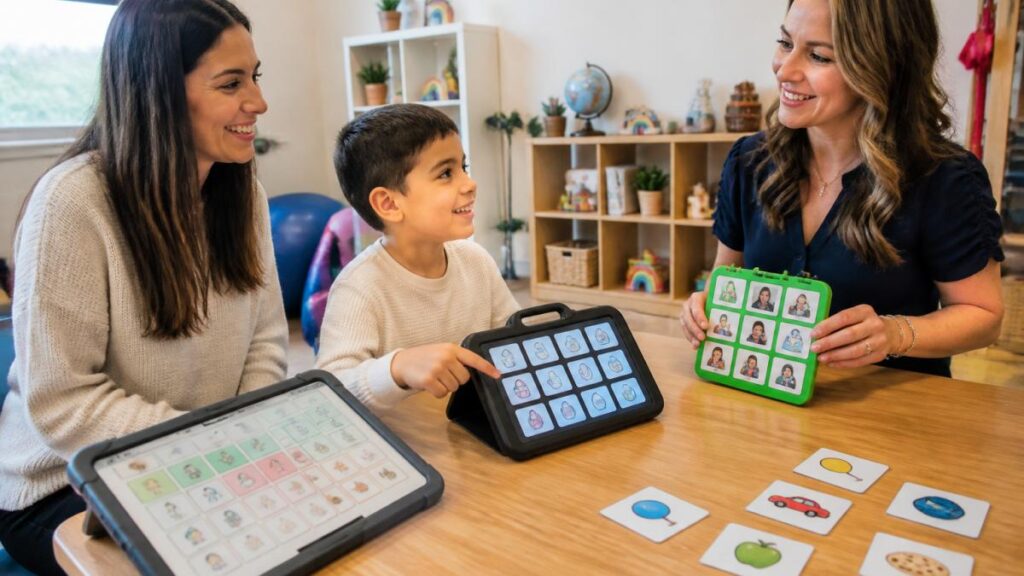
Aided AAC uses a tool. This is where most of the device decisions happen, and it splits into three practical tiers:
- No-tech: pointing, nodding, hand signals, and simple eye-blink responses. No equipment at all.
- Low-tech: paper communication boards, picture cards, symbol sheets, and single-message switches. Durable, inexpensive to replace, and easy to post on a fridge or classroom wall.
- High-tech: tablets and dedicated speech-generating devices (SGDs) with dynamic, changing screens. These can produce full sentences, store thousands of words, and grow with your child.
A common misconception is that high-tech is always the goal. It is not. A child with strong fine-motor skills may do beautifully with a paper board at meals and a tablet at school.
How Our Clinic Partners With Device Specialists
Picking a device is not a solo job, and it should not be a guess.
That partnership changes how trials work. Instead of ordering a device and hoping, we test options in sessions and watch how your child responds. We look at access methods, including:
- Direct touch: tapping buttons with a finger
- Switch access: using a larger button or sensor to scan and select
- Eye gaze: selecting items by looking at them
The specialist partnership also means better follow-through. We coordinate on setup, vocabulary organization, and troubleshooting, so you are not left guessing after the appointment.
If you are not sure where to start, that is normal. The first step is usually a trial, not a purchase.
Benefits of AAC for Children and Families
The benefits of AAC go far beyond words. Kids who get AAC support often show less frustration because they can finally express wants and needs. That shift eases meltdowns and builds confidence.
Families feel it too. When your child can tell you what hurts or what they want, daily life gets calmer. AAC also supports:
- Choice-making and independence
- Participation at school, meals, and play
- Language growth over time
- Stronger social connections
AAC is not a last resort. It is a bridge, and bridges help kids get where they are going faster.
AAC Awareness Month Activities You Can Start This October
Families can participate by learning more about AAC, modeling words on their child’s communication device, reading books together, or simply making an effort to include AAC in everyday conversations and routines.
Parents, you don’t have to be an AAC expert to make a difference. Start small this October by choosing one daily routine, like mealtime, playtime, or bedtime, and practice modeling a few words on your child’s AAC system without expecting them to respond or copy you.
Here are a few simple AAC activities you can try at home this month:
- Model during mealtime: Use your child’s AAC system to model words like eat, drink, more, good, or all done.
- Bring AAC into playtime: Model fun words such as go, stop, again, help, and my turn while playing with favorite toys.
- Read together: Pause during a favorite book and model words related to the pictures, characters, or what is happening in the story.
- Let your child make choices: Use AAC to offer choices about snacks, toys, clothes, activities, or what book to read.
- Practice commenting, not just requesting: Model words like wow, funny, yucky, cool, or I like it so AAC isn’t only used to ask for things.
- Keep AAC accessible: Make sure your child can reach their communication system throughout the day, not only during therapy or structured activities.
- Get the whole family involved: Encourage siblings, grandparents, and other caregivers to learn a few words on your child’s AAC system and model them too.
Most importantly, keep communication fun and meaningful. Celebrate all attempts to communicate, whether your child uses their device, gestures, sounds, signs, or spoken words. This AAC Awareness Month, choose just one or two of these ideas and start there. Small changes in your everyday routines can create more opportunities for your child to communicate, connect, and be heard.
Measure Whether It Made a Difference
You don’t need complicated data to know whether your AAC efforts are making a difference. At the beginning of the month, choose a few communication skills to pay attention to. Then check in again at the end of October and see what has changed.
Look for changes like:
- More AAC use: Is your child reaching for or using their AAC system more often?
- More independence: Are they communicating without always needing a reminder or prompt?
- More reasons to communicate: Are they using AAC to comment, protest, ask questions, greet others, or share ideas instead of only requesting?
- More initiation: Is your child starting conversations or interactions more often?
- Less frustration: Are they better able to communicate what they want, need, or feel?
- More engagement: Are they participating in conversations, play, books, or family routines for longer?
- More family involvement: Are parents, siblings, or other caregivers modeling AAC more naturally throughout the day?
Remember, progress with AAC isn’t just about counting how many words your child uses. Increased confidence, independence, participation, and connection are meaningful signs of progress too. At the end of the month, celebrate the small wins and choose one or two AAC habits your family can continue beyond AAC Awareness Month.
AAC at Home: Practical Guidance for Communication Partners
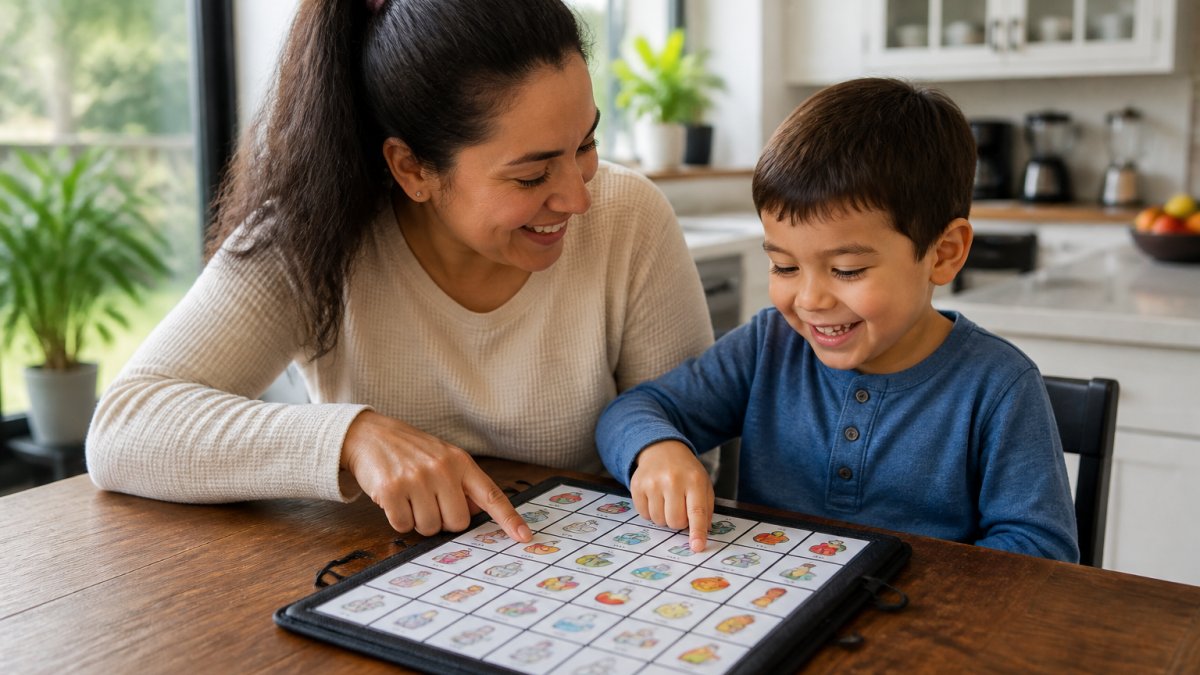
You are your child’s most important communication partner. That role is powerful, and it does not require a degree. It requires patience and a few good habits.
Start with these:
- Model without pressure. Use the device yourself as you talk.
- Give wait time. Pause for several seconds after you ask something.
- Follow their lead. Respond to whatever they communicate, even if it is not what you expected.
- Keep it in reach. A device locked in a cabinet helps no one.
A common mistake is treating AAC as a test the child must pass. It is not. It is a tool, and tools work best when they are always nearby and used by everyone.
Myths, Misconceptions, and the Evidence Behind AAC
Myths about AAC slow families down, and most of them are simply wrong. The biggest one is that AAC will make a child lazy and stop them from talking. The evidence points the other way.
Other common myths:
- “AAC is only for non-speaking kids.” Not true. It helps kids with partial speech too.
- “My child is too young.” Kids as young as toddlers can benefit.
- “It is too expensive.” Options range from paper boards to funded devices.
- “They will get stuck on it.” AAC grows with a child and changes over time.
What most guides miss is that AAC is a language system, not a gadget. The device is just the delivery method. The real work is teaching language, and that happens through daily use.
Turning Awareness Into Everyday Communication Access
The real challenge is not October. It is the other eleven months, when the routines take over. That is where communication access either grows or stalls.
At Project Speech, we help families keep the momentum going. Our clinic offers specialized pediatric speech therapy starting at 18 months, bilingual services, and care for kids through high school.
Get started with Project Speech and give your child a real path to being understood.
Frequently Asked Questions
What does AAC stand for?
AAC stands for augmentative and alternative communication. It covers every method a person uses to communicate beyond spoken words, including gestures, sign language, picture boards, and speech-generating devices. AAC supports communication access for people with autism, genetic conditions, speech sound disorders, and other needs. For children, AAC can be used alongside spoken language development, not instead of it.
What are the different types of AAC devices for children?
AAC devices fall into two broad categories: unaided and aided. Unaided AAC uses only the body, such as gestures, facial expressions, and sign language. Aided AAC uses external tools, from low-tech options like picture boards and communication books to high-tech speech-generating devices. Many children start with a simple board and later move to a dedicated device as their needs grow. A speech-language pathologist can help match the right type to your child.
Can a child use AAC while still developing spoken language?
Yes. Research consistently shows that AAC does not stop children from learning to speak. In fact, using AAC can support spoken language development by reducing frustration and giving children a way to practice communication. Many children use AAC and spoken words together. If you are concerned about your child’s speech, a speech-language pathologist can assess whether AAC is a good fit.
How can parents support AAC use at home?
Parents can support AAC at home by modeling its use during everyday routines like mealtimes, bath time, and play. Keep the device or board accessible, not put away in a drawer. Use wait time after asking a question so your child has a chance to respond. Celebrate every attempt at communication, whether it is a word, a gesture, or a button press. Your clinic can provide extra home training to help you feel confident.