
Table of Contents
- How Speech Therapy Supports Communication in Autistic Children and Adults
- Signs Your Child May Benefit From Autism Speech Therapy
- Autism Speech Therapy Techniques Used in Sessions
- AAC for Autism: Communication Beyond Spoken Words
- Speech Therapy Activities for Autism at Home
- Paying for and Accessing Speech Therapy: Insurance, Referrals, and What to Ask
- Frequently Asked Questions
Last Updated: October 5, 2026
How Speech Therapy Supports Communication in Autistic Children and Adults
Speech therapy for autism spectrum disorder is a structured, individualized approach that builds communication skills across a person’s entire life. At Project Speech, therapy works best when it’s built around how your child already communicates, not around forcing spoken words first.
Most guides treat speech therapy as a fix for a deficit. In practice, it’s scaffolding: meet a person where they are, then build outward.
What a Speech-Language Pathologist Does
A speech-language pathologist is a licensed clinician who assesses and treats communication challenges, including expressive language, receptive language, social communication, and speech sound production.
The American Speech-Language-Hearing Association overview of autism outlines how SLPs assess communication strengths before writing any treatment plan. That assessment step matters. A good clinician maps what a person can already do, then designs therapy around those strengths rather than a generic checklist.
Signs Your Child May Benefit From Autism Speech Therapy
Many parents notice something first: a toddler not babbling by 12 months, a preschooler echoing phrases without using them to ask for things, or a school-aged child avoiding peer interaction because conversation feels exhausting.
A common mistake is waiting for a formal diagnosis before seeking an evaluation. You don’t need one. Speech and language delay can be assessed on its own, and early intervention tends to produce better long-term communication development.
- Limited eye contact or joint attention during play
- Fewer words than expected for the child’s age
- Difficulty following simple directions
Autism Speech Therapy Techniques Used in Sessions
Autism speech therapy techniques vary widely, and may not look different from therapy techniques used with a child who solely has a language disorder. The evidence base is not equally strong for all therapy techniques, some approaches are not as strongly supported by research when compared to others. Here are examples of some therapy techniques:
Visual supports and structured teaching. Schedules, first-then boards, visual task sequences, and Social Stories.
Social skills groups and peer-mediated instruction. These target conversation, turn-taking, and peer interaction in a group format.
Individual therapy works for focused goals; group therapy adds peer interaction practice that’s hard to replicate one-on-one.
Neurodiversity-Affirming Practice: What It Looks Like in the Room
The techniques above describe what gets taught. Neurodiversity-affirming practice describes how, the piece most guides skip.
An affirming clinician treats autism as a different way of experiencing and communicating, not a deficit to erase. In practice:
- Goals come from the autistic person’s priorities, not only from parent or clinician preferences. For a nonverbal teen, that might mean learning to decline, negotiate, or ask for sensory accommodations, not learning to say “hello” on demand.
- Sensory needs are treated as real. A session in a loud, bright room with a scratchy chair is not a fair test of anyone’s communication skills. Each child has different sensory needs to be successful and they should be honored.
Customizing the session to your child’s needs is key. Skills a person chooses to use tend to generalize; skills trained under pressure often don’t.
Speech Therapy Across the Lifespan
Most articles stop at childhood. Communication needs don’t.
Adults. Speech therapy for autistic adults may focus on job interviews, workplace communication, dating and relationships, and managing sensory load in public.
Changing support needs. A person who used a device heavily at age 8 may rely on speech at 25 and return to the device during burnout or illness.
If you’re an autistic adult seeking services, you can contact an SLP directly in most states without a physician referral, though insurance may still require one for coverage.
AAC for Autism: Communication Beyond Spoken Words
AAC for autism covers any system that supplements or replaces spoken language, including picture boards, speech-generating devices, and sign systems. The persistent myth is that AAC delays speech; research says the opposite, giving someone a reliable way to communicate often reduces frustration and can support spoken language development rather than replace it (Augmentative and Alternative Communication in Early Intervention).
Speech Therapy Activities for Autism at Home
Home practice is where progress compounds. Ten focused minutes a day beats one long weekend session, because communication skills need repetition in real contexts, and home is the most real context there is.
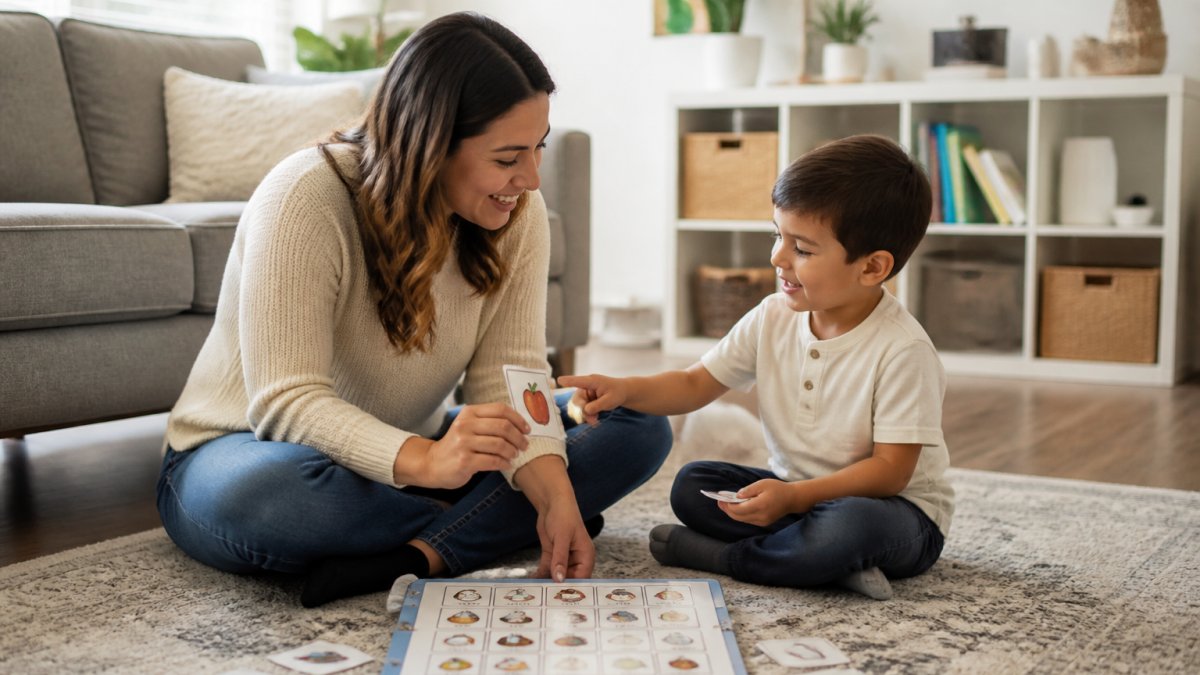
Parent and child using picture cards for speech therapy at home
The activities below are organized by what they train, not by age, a 4-year-old and a 14-year-old can work on the same underlying skill with different materials.
Building Requests and Protests
Requesting is often the first functional communication goal, and protesting, saying “no” or “stop”, is just as important and far less often taught.
- Offer choices between two items and wait. Hold both items up, name them, and give at least 5-10 seconds of silence. Rushing to repeat the question removes the child’s opportunity to respond.
- Sabotage gently. Put a favorite snack in a sealed jar, or hand over a puzzle with a missing piece. The obstacle creates a real reason to communicate rather than a prompted one.
- Teach “no” and “break” explicitly. If a child only has words for what they want, they have no reliable way to stop something aversive. Model “no,” “stop,” “break,” or the equivalent on a device, and honor it the first time.
Building Joint Attention and Turn-Taking
Joint attention, sharing attention with another person on the same object, is foundational social communication, and it’s trainable in short bursts.
- Follow the child’s lead during play instead of redirecting it. If they’re lining up cars, line up cars with them, then add one move: send a car down a ramp and look at them expectantly. You’re building a back-and-forth, not changing the game.
- Use people games with predictable pauses. Songs like “Row, Row, Row Your Boat” or routines like swinging have built-in stops. Pause at the same point each time and wait for a signal, a look, a sound, a gesture, a word, before continuing.
- Narrate your day in short, simple phrases during routines like meals and bath time. Keep phrases one step above what the child currently produces, not three.
Using Visual Supports and AAC at Home
- Keep a communication board or device accessible in every room, not in a backpack or on a high shelf. A communication tool that requires an adult to fetch it is not a communication tool; it’s a request form.
- Use visual supports for schedules and transitions. A first-then board (“first dinner, then tablet”) reduces the language load during the moments when language is hardest to process.
- Model on the device yourself. If your child uses an AAC system, use it to talk to them during the day. Partner modeling is one of the strongest predictors of AAC uptake, and it signals that the device is a real way to communicate, not a therapy exercise.
Making It Stick
- Tie practice to the goals on the plan. If the goal is “request an item in 4 of 5 opportunities,” your home practice is creating opportunities and tracking hits, not running a separate curriculum.
- Track it simply. A tally on the fridge or a note in your phone is enough. Bring the data to the next session; clinicians can adjust goals far faster with real numbers than with a general impression.
- Stop while it’s still fun. Ending on a success is more likely to bring the child back tomorrow than pushing through to a meltdown.
The CDC’s guidance on autism and communication milestones is a useful reference for what to expect at each age, though every child’s timeline differs. If your child is not yet using words, the activities above still apply, swap spoken language for signs, pictures, or a device.
Paying for and Accessing Speech Therapy: Insurance, Referrals, and What to Ask
Access is often the hardest part. Insurance coverage for speech therapy depends on your plan, whether therapy is deemed medically necessary, and whether the provider is in-network. Many plans require a pediatrician referral before covering an evaluation.
Because coverage and cost vary so much, we can’t quote a number for your family. What to ask before you commit:
- Is the evaluation covered separately from treatment?
- How many visits per year does my plan authorize?
- Do you need a diagnosis code, and which one?
For families in our area, Project Speech offers clinic-based pediatric services starting at 18 months, with bilingual speech-language pathology support and care extending through highschool.
Finding the right communication support for an autistic child or adult takes patience, and the system doesn’t always make it easy. If you’re in the Boynton Beach area and want a team that builds therapy around your child’s actual strengths, Project Speech provides specialized pediatric speech therapy in a family-centered clinic setting, with bilingual clinicians, individualized treatment plans, and integrated speech and occupational therapy services when needed.
Frequently Asked Questions
Can speech therapy help with autism?
Yes. Speech therapy addresses communication challenges common in autism spectrum disorder, including expressive language, receptive language, social communication, and functional communication. A speech-language pathologist assesses each person’s strengths and needs, then builds individualized treatment around practical goals like requesting, answering questions, or starting a conversation. Therapy can help whether someone speaks fluently, uses few words, or communicates nonverbally with AAC.
What does speech therapy for autism involve?
Sessions typically begin with a communication assessment covering vocabulary, articulation, pragmatic language, and social interaction. From there, the speech-language pathologist sets individualized treatment goals and uses speech therapy techniques such as play-based learning, visual supports, and modeling. Sessions may be individual or group therapy, in a clinic or through teletherapy, and usually include home practice so caregivers can reinforce skills during everyday communication.
Can speech therapy help a child who does not speak?
Yes. Speech therapy is not only about verbal communication. For children who do not speak, a speech-language pathologist may introduce AAC for autism, including picture boards, sign language, or speech-generating devices. The goal is functional communication, meaning the child can express needs, make choices, and participate in social interaction in whatever way works for them. Research supports AAC as a tool that can support, not replace, spoken language development.
What is the difference between speech therapy and ABA therapy?
Speech therapy focuses specifically on communication skills: expressive language, receptive language, social communication, and speech sounds. ABA therapy addresses a broader range of behaviors and skills using behavioral principles. The two often work together, and a speech-language pathologist and behavior analyst may coordinate goals. If you are deciding between them, ask each provider how they measure therapy progress and how they communicate with the other professionals on your child’s team.
How can parents support communication at home?
Parents and caregivers play a central role. Ask your speech-language pathologist which speech therapy activities at home fit your child’s goals, then build them into daily routines like meals, bath time, and play. Simple strategies include narrating what you are doing, pausing to give your child time to respond, using visual supports, and following your child’s lead during play-based learning. Consistent, low-pressure home practice between sessions supports therapy progress.
How do I know if my child needs a speech therapy evaluation?
Consider an evaluation if your child has limited vocabulary for their age, rarely responds to their name, does not use gestures or eye contact to communicate, loses language they once had, or struggles with conversation skills and peer interaction. Early intervention tends to produce better outcomes, so it is reasonable to seek an assessment rather than wait. A speech-language pathologist can determine whether a speech and language delay is present and what support makes sense.