

Table of Contents
- What a Speech-Language Pathologist Does and When to Seek One
- How to Find a Qualified Speech Language Pathologist Near You
- What to Expect During a Speech and Language Evaluation for Children
- Speech Therapy Insurance Coverage: What Families Should Know
- Speech Therapy for Preschoolers: Early Intervention and Enrichment
- AAC Device Coaching for Parents: Supporting Communication at Home
- In-Person Therapy vs. Teletherapy: Which Fits Your Family?
- Conclusion: Taking the Next Step Toward Communication Support
- Frequently Asked Questions
Last Updated: October 14, 2026
What a Speech-Language Pathologist Does and When to Seek One
A speech-language pathologist is a licensed healthcare professional who evaluates, diagnoses, and treats communication and swallowing disorders in children and adults. If you’ve been typing “speech language pathologist near me” into your phone at 11 p.m. while your three-year-old sleeps, you’re in the right place.
An SLP does far more than fix “R” sounds. SLPs address speech sounds, language comprehension and expression, social communication, fluency, voice, feeding, and augmentative and alternative communication (AAC).
Signs Your Child May Benefit From an Evaluation
Trust your gut, but know the general markers. A child who isn’t using words by around 18 months, isn’t combining two words by age two, or is hard for unfamiliar adults to understand by age three is a reasonable candidate for a speech and language evaluation for children. Older kids may struggle with following directions, telling a story in order, or being understood by peers.
Other signs worth a closer look:
- Frustration or meltdowns when trying to communicate
- Avoiding social play or preferring to play alone
- Stuttering that persists past six months
How to Find a Qualified Speech Language Pathologist Near You
Finding a qualified speech language pathologist near you comes down to three moves: verify the credentials, ask the right questions, and confirm the logistics before you book.
How to Verify Licensure and Clinical Credentials
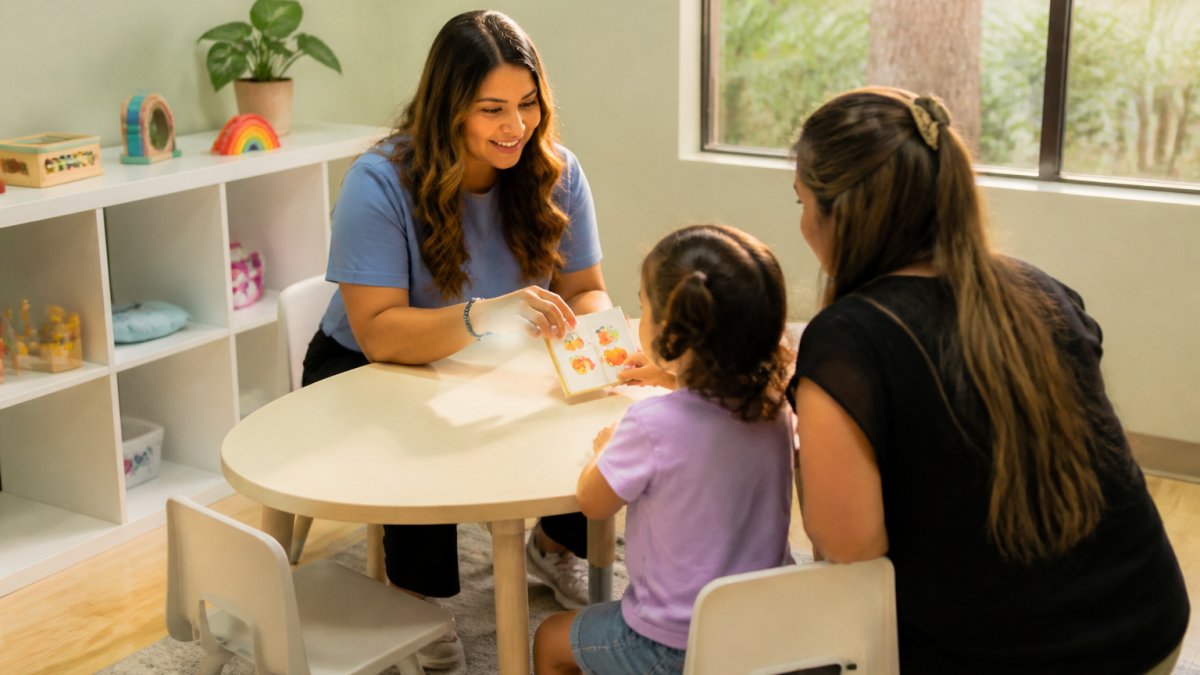
Look for the letters CCC-SLP after a therapist’s name. That stands for Certificate of Clinical Competence in Speech-Language Pathology, awarded by the American Speech-Language-Hearing Association. You can check a clinician’s status through the ASHA certification verification tool.
Beyond the alphabet soup, ask about experience with your child’s specific profile. A therapist who’s brilliant with articulation may not be the right fit for a nonverbal child using AAC.
Questions to Ask Before Scheduling an Appointment
Bring this list to your first call.
- How many years have you worked with children in my child’s age range?
- Do you have experience with my child’s diagnosis or communication profile?
- Do you offer bilingual services if our family needs them?
What to Expect During a Speech and Language Evaluation for Children
A speech and language evaluation for children is a structured session, usually 45 to 90 minutes, where the SLP gathers information through play, standardized testing, and parent interview. Knowing the full sequence helps you prepare.
The Referral and Intake Pathway
There are three common ways families arrive at an evaluation:
- Pediatrician referral. Your child’s doctor notes a concern at a well-child visit and sends a referral. This is the most common path and often the fastest for insurance approval.
- Self-referral. You call a clinic directly because of a concern you’ve noticed at home. In most cases you do not need a physician’s referral to schedule, though your plan may require one for coverage.
- School or early intervention referral. If your child attends preschool or a childcare program, a teacher or provider may raise a concern and connect you with a screening.
Once you contact a clinic, expect an intake call covering your child’s age, your main concern, your insurance plan, and your availability. Some clinics schedule the evaluation on that call; others place you on a waitlist.
Before the Appointment
You’ll typically fill out a developmental history form beforehand covering pregnancy and birth history, first words, current vocabulary, medical conditions, ear infections, and family history of speech or language difficulties. Bring any prior reports, IEP documents, or therapy notes.
A few practical preparations that make the session smoother:
- Schedule the evaluation for a time your child is usually alert and fed, not during nap time.
- Bring a favorite snack, a comfort item, and a familiar toy.
- Write down your top three concerns so you don’t forget them in the moment.
During the Session
The therapist may assess:
- Receptive language (what your child understands)
- Expressive language (how your child communicates)
- Speech sound production and intelligibility
For young children, much of this happens through play. The SLP may present picture books, toys, and simple games while tracking which sounds, words, and sentence structures your child produces. Standardized tests are used when age and attention span allow, and parent interview is a major component, the SLP wants to know how your child communicates at home, not just in a clinic room.
After the Evaluation
You should receive a written report with a diagnosis (if one applies), recommendations, and proposed goals. The report typically includes:
- Standard scores and percentile ranks from any standardized testing
- A summary of strengths and areas of need
- A diagnosis or diagnostic impression
Timelines vary. Some clinics provide a verbal summary the same day and a written report within one to two weeks.
If therapy is recommended, the next step is usually a separate scheduling call. If your child is not yet ready, the SLP may suggest a re-evaluation in a few months or a home program.
Project Speech offers speech and language screenings and hearing screenings as a starting point when you’re not sure whether a full evaluation is warranted. A screening is shorter than an evaluation and tells you whether a deeper look makes sense.
Speech Therapy Insurance Coverage: What Families Should Know
Speech therapy insurance coverage varies widely, and the details live in your specific plan document. Many plans cover medically necessary speech therapy, but definitions differ, and some plans cap visits per year or require a referral and prior authorization.
The Questions That Actually Get Answers
When you call the member services number on your insurance card, ask these instead:
- Is speech therapy a covered benefit under my plan, and is it subject to a separate visit cap?
- Does the plan require a physician referral or prior authorization before the first visit?
- Is the provider I’m considering in-network? If not, what is my out-of-network reimbursement rate?
Write down the representative’s name, the date, and the call reference number. If a claim is later denied, that record helps.
Comparing Out-of-Pocket Costs Across Providers
Even when two providers are both in-network, your out-of-pocket cost can differ. Factors include:
- Session length. A 30-minute session and a 60-minute session may bill differently.
- Billing codes. Evaluations, treatment sessions, and screenings use different codes, and your plan may cover them at different rates.
- Visit limits. If your plan caps visits per calendar year, a provider recommending three sessions per week will exhaust that cap faster than one recommending one session per week.
Ask each provider’s billing office for a written estimate of what you’ll owe per session based on your plan.
If You Don’t Have Coverage or Have Exhausted It
Options families commonly use:
- Private pay. Many clinics offer a self-pay rate which is a discounted version of the insurance negotiated rate.
- Step Up For Students Scholarship. The state of Florida allows this scholarship to cover speech therapy costs.
- School-based services. If your child qualifies, public school districts provide speech therapy at no cost to families through an IEP or a 504 plan.
If a Claim Is Denied
Denials happen, and they are often reversible. The U.S. Department of Health and Human Services publishes consumer resources on understanding your health coverage and appealing denied claims. If a claim is denied, you generally have the right to appeal. The appeal usually requires a letter from the provider explaining medical necessity, so ask your SLP’s office to supply one.
Speech Therapy for Preschoolers: Early Intervention and Enrichment
Speech therapy for preschoolers looks different from therapy for older kids. Sessions lean on play, books, songs, and movement because that’s how three- and four-year-olds learn language best.
Some children need individualized one-on-one therapy. Others benefit from a group setting where they practice communication with peers.
That’s the idea behind our Little Language Explorers preschool enrichment group, launching January 2027 for children ages 3 and 4.
AAC Device Coaching for Parents: Supporting Communication at Home
AAC device coaching for parents teaches caregivers how to model and support their child’s communication device during everyday routines.
The device isn’t the intervention, how consistently the adults around the child use it is. A device that sits in a backpack during dinner isn’t providing AAC support.
Coaching typically covers:
- How to model language on the device without demanding a response
- Where to keep the device so it’s always accessible
- How to build device use into meals, bath time, and play
Project Speech offers parent AAC device coaching as part of our family-centered approach, alongside speech and language screenings, hearing screenings, evaluations, and one-on-one therapy.
In-Person Therapy vs. Teletherapy: Which Fits Your Family?
In-person therapy works best for young children who need hands-on cues, movement-based sessions, and structure. Teletherapy works well for older kids, busy schedules, and families without reliable transportation. Many clinics offer both.
|
Factor |
In-Person |
Teletherapy |
|---|---|---|
|
Best age range |
Toddlers and preschoolers |
School-age and teens |
|
Hands-on cues |
Yes |
Limited |
|
Scheduling flexibility |
Moderate |
High |
|
Parent involvement |
In-room |
Often required |
|
Travel time |
Required |
None |
Neither option is universally better. The right choice depends on your child’s age, attention span, and how well they engage through a screen.
Conclusion: Taking the Next Step Toward Communication Support
If you’ve read this far, you already suspect something needs attention. The hard part isn’t knowing whether to act. It’s finding a provider who actually understands your child’s profile and your family’s life.
At Project Speech, we provide specialized pediatric speech therapy in a family-centered clinic setting in Boynton Beach, with bilingual support for children from 18 months through high school.
Frequently Asked Questions
How do I find a speech-language pathologist near me for my child?
Start by asking your pediatrician for a referral, then check your insurance company’s online directory of in-network providers. You can also search professional association directories that list certified speech-language pathologists by location and specialty. When you have a shortlist, call each clinic to confirm they serve your child’s age range, ask about their experience with your child’s specific communication needs, and verify credentials. If you are in the Boynton Beach area, Project Speech offers pediatric services starting at 18 months, including bilingual support and one-on-one therapy.
Does health insurance cover speech therapy for children?
Many insurance plans cover speech therapy when it is medically necessary, but coverage varies widely by plan and state. Before scheduling, call your insurance company and ask specifically about speech therapy benefits, whether a referral or prior authorization is required, how many visits are covered per year, and what your copay or coinsurance will be. Some plans require a physician’s order. If coverage is limited, ask the clinic about payment options or sliding-scale programs. Project Speech can help you understand what your plan covers before you begin.
What is the difference between a speech screening and a full evaluation?
A speech screening is a brief check that identifies whether a child might have a communication difficulty and should be looked at more closely. It does not provide a diagnosis. A full evaluation is a comprehensive assessment conducted by a speech-language pathologist that examines speech sounds, language comprehension and expression, fluency, voice, and social communication. The evaluation results in a diagnosis and an individualized treatment plan if therapy is needed. Project Speech offers both screenings and comprehensive evaluations, so families can start with the level of assessment that fits their concerns.
Can a speech-language pathologist help with AAC devices?
Yes. Speech-language pathologists assess whether a child would benefit from an augmentative and alternative communication (AAC) device, help select and set up the right system, and train both the child and family members to use it effectively. AAC can support children who have limited verbal speech due to autism, developmental differences, or other conditions. Project Speech offers AAC device coaching for parents, which gives families the skills to model and reinforce device use during everyday routines at home, not just during therapy sessions.