Table of Contents
- Why Hearing Screenings Matter for Children’s Speech Development
- What Happens During a Child Hearing Test
- Hearing Screening Referral After a Failed Screening
- Frequently Asked Questions
Last Updated: October 15, 2026
Why Hearing Screenings Matter for Children’s Speech Development
Hearing screenings are quick, painless checks of whether a child’s ears pick up sound clearly, not a diagnosis, just a first look.
At Project Speech, we see how closely listening and talking are tied: a child who cannot hear clearly often cannot repeat sounds clearly. Babies learn speech by listening, copying, and adjusting; if sounds arrive muffled or missing, that loop breaks. That is why the importance of hearing screenings for children cannot be overstated, catching a problem early gives a child the best shot at catching up.
October is Audiology Awareness Month, a good reminder to check your child’s hearing health. If you have concerns, talk to your pediatrician or an audiologist. If your child is 3 or older and you are worried about speech, Project Speech offers hearing screenings for children age 3 and up at our clinic.
Signs to watch for:
- Does not turn toward loud sounds
- Says “what?” often or asks for repeats
- Turns the TV up louder than others need
- Speaks unclearly or leaves out sounds
- Seems tired or distracted in group settings
- Watches faces closely to understand speech
What Happens During a Child Hearing Test
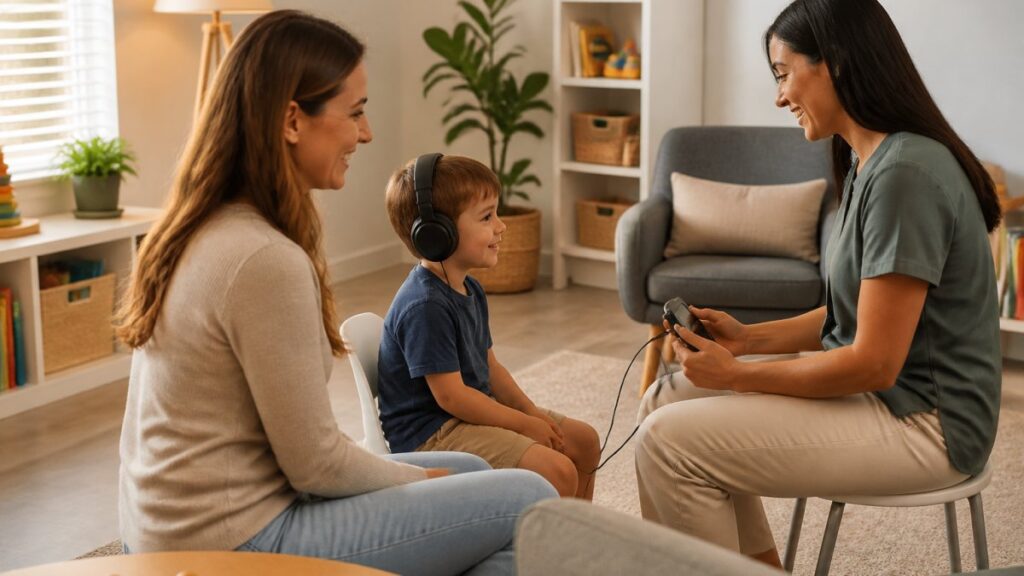
A child hearing test is usually calm, short, and play-based, taking just a few minutes with no pain.
What to expect:
- A quiet room with soft lighting and toys
- Small headphones or soft earplugs
- Gentle sounds at different pitches and volumes
- Your child raises a hand, presses a button, or looks toward the sound
- The screener records which sounds your child heard
For babies, tests look different: soft clicks measure how the ear responds, or the screener watches how the baby reacts to sound.
Tips to make the visit easier:
- Pick a time when your child is rested and fed
- Bring a favorite small toy or blanket
- Explain that it is like a listening game
- Stay calm, your child picks up on your mood
Hearing Screening Referral After a Failed Screening
A “refer” result does not mean your child has hearing loss. It means the screening could not confirm clear hearing, so more testing is needed.
Common causes of a refer result:
- Fluid behind the eardrum from a recent cold
- Earwax blocking the canal
- A noisy room during the test
- Your child was distracted or moving around
That is why a repeat screening is often the first step. If it still shows a refer result, the next step is a full hearing evaluation with an audiologist, a longer, more detailed visit that can tell you exactly what is going on.
Do not wait months to follow up. Early identification opens the door to early intervention, which protects speech, language, and learning. If you’re concerned that your child’s hearing may be affecting their speech and language development, we’re here to help! At Project Speech, we can perform a hearing screening to identify potential hearing concerns and determine whether further evaluation by an audiologist is recommended.
Frequently Asked Questions
At what age should children start hearing screenings?
Newborns are typically screened before leaving the hospital. The American Academy of Pediatrics recommends ongoing screening at well-child visits, with formal screenings starting around age 3. Project Speech offers hearing screenings for children age 3 and older, and October is Audiology Awareness Month, a good reminder to check your child’s hearing health.
What should parents do if their child does not pass a hearing screening?
A refer result does not always mean permanent hearing loss. It may be caused by fluid, wax, or a temporary condition. Your child should receive a diagnostic evaluation from an audiologist. Early follow-up is key. If hearing loss is confirmed, early intervention and speech therapy can support language development. Contact your pediatrician or a speech-language pathologist for guidance.
Does a child who passes a hearing screening need another one later?
Yes. Hearing can change over time, and some children develop hearing loss after infancy. Routine screening at well-child visits, and ongoing school-age screening, helps catch changes early. If you notice signs of hearing loss in children, such as turning up the TV or not responding to their name, ask for a repeat screening even if they passed before.
Hearing concerns can feel scary, but you do not have to sort them out alone. Project Speech offers specialized pediatric speech therapy and hearing screenings for children age 3 and older in a family-centered clinic. Our bilingual speech-language pathologists support children from 18 months through high school, with care built around your child’s needs. Contact us today to schedule a screening or ask about next steps.